


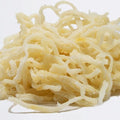
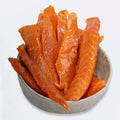

Kambala is the Russian word for flounder, a flatfish. Salted and air-dried, it is the fish most of our customers mean when they type "taranka" into a search bar: something flat, salty and chewy that you pull apart with your fingers over a beer. Ours is Flounder (Dried Kambala): wild Atlantic flounder, salt, and slow air. Nothing else goes in.
What kambala is
Kambala (камбала) is flounder. It is a flatfish: it lives on the sea floor on one side, with both eyes on top. The body is thin and wide and the flesh is lean, which is why it dries so well. A thick, oily fish dries from the outside in and can stay soft in the middle. A flounder dries evenly all the way through.
Ours is caught wild in the cold Atlantic off Massachusetts. People also search for it as dried flatfish, dry flounder or kambala fish. All of those are the same product.
Taranka and dried flounder
Taranka (таранка) started as the name of one fish. Taran is a relative of the roach that lives in the Sea of Azov and runs up the Don. Vobla is its cousin from the Volga and the Caspian. Both were salted and dried in the sun by the ton, and for a century they were the fish you saw next to a glass of beer from Rostov to Vladivostok.
Over time the word came loose from the fish. Today taranka means any dried salted fish you eat with beer, whatever the species. In the US, people who grew up with the habit type it into Google to find the category. That search usually lands on flounder or smelt, because the Volga fish are not caught on this side of the ocean.
Flounder is our answer to that search. It is a different fish. The job is the same: flat, light, salty enough to want a drink, and it comes apart into strips you can pass around a table. It is milder than dried squid and less salty than most dried fish, so it does not fight the beer.
How to take dried flounder apart
No knife. Dried flounder is meant to be taken apart by hand, and a blade crushes the strips instead of separating them.
Warm it first. Half a minute on each side in a dry pan, no oil, softens the skin and wakes up the smell. Cold from the fridge it is stiffer and the skin fights you.
Fins first. Run your thumb along the edge of the fish and pull the fringe of fins away. They come off in one strip on each side and are the crunchiest part.
Then the skin. Start at the tail end, lift a corner, and peel toward the head end. On a well-dried fish the skin comes away in one or two pieces.
Then the strips. With the skin gone, the flesh lies in two flat halves on either side of the spine. Pull a strip from the spine outward and it separates along the grain, thin and slightly translucent when you hold it up to the light.
Taken apart, one fish is a pile of strips that four people can pick at for an hour.
What to eat dried flounder with
Beer, first of all. A lager or a pilsner, cold, the plainer the better. The fish carries the salt, so the beer does not need to. We wrote more about matching fish snacks to beer here.
A piece of rye bread next to it. Dark, dense, no butter. You take a strip of fish and a bite of bread, and the bread takes the edge off the salt.
Fish soup, if you have a whole fish left over. Soak it in cold water for a few hours to draw out the salt, then put it in the pot as you would any dried fish for stock. The broth comes out clear, and the strips soften back into something close to fresh flounder.
A dried fish keeps. Unopened, dried flounder is good for one to three months. Once opened, keep it in the fridge wrapped in paper so it does not sweat. We wrote up storage for all our fish here.
How dried flounder is made
Two ingredients: the fish and salt.
Flounder dries evenly because it is thin and lean. That is why the flesh comes off the bone in flat, translucent strips and never in crumbs.
The flounder is wild, from the cold Atlantic off Massachusetts. It comes to us whole, gets salted, and then hangs to dry in moving air at a controlled temperature. There is no oven and no smoke. Heat would cook the surface and leave the inside soft. Slow air takes the water out a little at a time, and that even drying is what lets the flesh come off in clean strips.
No sugar and no preservatives. Salt and time do the keeping, the way it has been done on every coast where fish had to last through winter.
We dry flounder because taranka is what people ask us for, and vobla does not swim in the Atlantic. Flounder is what this ocean gives us. It dries the way we remember dried kambala from Sakhalin, and on a Friday evening it does the same work a taranka ever did. That was enough to put it on the shelf.
